The finding
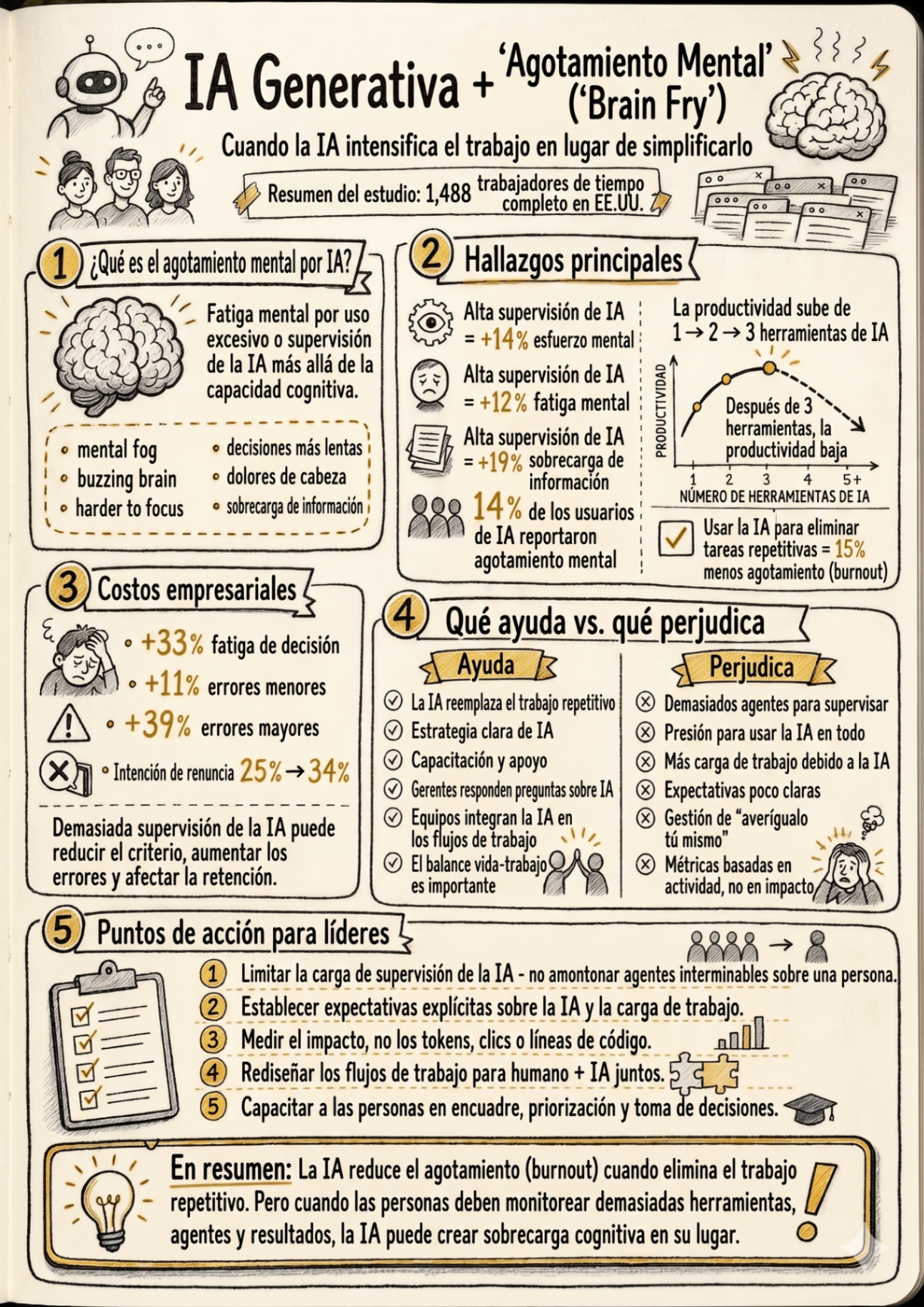
A study of 1,488 full-time US workers shows the same tool that should reduce cognitive load is, in many deployments, increasing it. The mechanism is oversight: when people are asked to supervise too many AI tools, agents and outputs, AI stops being a productivity lever and becomes a source of mental fatigue.
AI reduces burnout when it removes repetitive work. It creates burnout when people are forced to monitor too many tools, agents and results.
What the data shows
- High AI oversight = +14% mental effort
- High AI oversight = +12% mental fatigue
- High AI oversight = +19% information overload
- 14% of AI users report mental exhaustion
- Productivity rises from 1 → 2 → 3 AI tools, then declines after 3
- Using AI to eliminate repetitive tasks = 15% less burnout
The business cost
- +33% decision fatigue
- +11% minor errors, +39% major errors
- Intent to quit moves from 25% → 34%
What helps vs. what hurts
Helps: AI replacing repetitive work, a clear AI strategy, training and support, managers answering questions, teams integrating AI into real workflows, work-life balance.
Hurts: too many agents to supervise, pressure to use AI for everything, more workload because of AI, unclear expectations, "figure it out yourself" management, activity-based metrics instead of impact-based ones.
Five actions for leaders
- Cap AI oversight load. Do not stack endless agents on a single person.
- Set explicit expectations on AI use and workload.
- Measure impact, not tokens, clicks or lines of code.
- Redesign workflows for human + AI together — not human supervising AI.
- Train people in framing, prioritisation and decision-making — the parts AI cannot do.
Bottom line
AI is a productivity multiplier up to a point — and a cognitive tax beyond it. The companies that win will not be those deploying the most tools, but those designing the supervision load deliberately.