by Alvaro de Nicolas
Table of Contents
AI as the Backbone of Temporary Teams
The “Always Ready” Executive Assistant
AI in Recruitment and Workforce Management
AI’s Role in Performance Management
Rethinking Compensation, Benefits, and Career Progression
The CIO Evolution: From AI Enabler to AI Guarantor
Role of Partners, Suppliers, and Integrators in an AI Workforce
AI in Budgeting and the Pace of Transition
Who Wins, Who Loses? Societal Implications
Key Ethical and Regulatory Questions
Short-Term vs. Long-Term Implications
Best/Worst/Likely Scenarios
Actionable Steps & Conclusion
1. AI as the Backbone of Temporary Teams
“AI will no longer be a mere productivity tool but a foundational element in the structure of work.”
AI will no longer be a mere productivity tool but a
foundational element in the structure of work.
Instead of long-term hierarchical organizations,
AI will facilitate the seamless creation and dissolution of teams based on project
needs. Workers will be able to:
Utilize
personal AI assistants trained
on their work habits, strengths, and specializations.
Collaborate with corporate AI systems
to optimize task distribution and workflow efficiency.
Access AI-driven knowledge
bases that instantly provide relevant insights and recommendations.
Adjust work schedules dynamically
based on real-time project needs and skill availability.
For example, a marketing expert might work on brand positioning for a tech startup on
Monday
, switch to
AI-driven content strategy development for a media company on
Tuesday
,
and assist a multinational corporation with consumer analytics on
Wednesday
. AI will seamlessly coordinate these transitions,
dynamically adjust
the
national insurance
contribnution and the
work insurance
as well as the
expected taxes and pension
ensuring that every individual contributes effectively without administrative burden.
A marketing expert might handle:
Monday
: Brand positioning for a tech startup.
Tuesday
: AI-driven content strategy for a media company.
Wednesday
: Consumer analytics for a multinational corporation.
AI seamlessly coordinates
all these transitions, automatically adjusting taxes, insurance, and pension contributions—reducing administrative burden for both worker and employer.
2. The “Always Ready” Executive Assistant
2.1 Strategic AI Coordinators
“Executive assistants will transition into strategic AI coordinators and workflow optimizers.”
In this evolving landscape,
the role of executive assistants
will also undergo a profound transformation. Instead of managing calendars and handling traditional administrative tasks,
executive assistants will become strategic AI coordinators and workflow optimizers
. They will oversee AI-driven scheduling, ensuring that high-level executives are efficiently engaged with the most pressing tasks at any given time. Additionally,
they will act as human-AI liaisons,
interpreting complex AI-generated insights, curating critical information for decision-making, and
ensuring that executives maintain a personal touch
in an increasingly automated environment.
Moreover, executive assistants will facilitate
seamless collaboration between different AI tool
s used by their executives,
training
their behaviour and
optimizing AI outputs
to suit their leaders' preferences and business needs. They may also be responsible for maintaining the
ethical oversight of AI interactions,
ensuring data privacy compliance, and detecting biases in AI-driven recommendations. In essence, their role will shift
from administrative support to strategic augmentation
, making them indispensable in this new paradigm of AI-enhanced productivity.
Required Skills for Future Executive Assistants
To prepare for this transition, executive assistants will require
specialized training
that extends
beyond traditional administrative skills.
Their education will need to include:
AI Literacy and Operations
: Understanding AI-driven workflows, optimizing machine-generated insights, and troubleshooting automated processes.
Data Privacy and Security
: Learning best practices for handling sensitive information in AI ecosystems and ensuring compliance with evolving digital governance laws.
Strategic AI Management
: Developing skills to oversee and fine-tune AI performance, including prompt engineering and AI-agent coordination.
Decision-Augmentation and Interpretation
: Enhancing their ability to synthesize AI-generated data into actionable insights, ensuring executives receive contextually relevant and strategic guidance.
Emotional and Human-Centric Leadership
: Balancing the efficiency of AI with the emotional intelligence required to maintain strong interpersonal relationships within organizations.
As a result,
executive assistants will evolve into AI augmentation specialists,
ensuring that AI serves as a powerful tool rather than an impersonal barrier between executives and their teams. Their value will be in
bridging human judgment with machine efficiency
, not only for theirm executives but for the teams and Senior managers they lead,
making them key players in an AI-augmented business world.
.
3. AI in Recruitment and Workforce Management
“Recruitment will transform into an ongoing AI alignment process.”
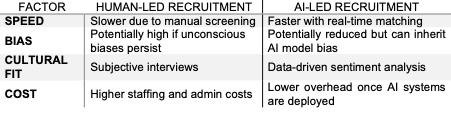
AI will revolutionize the hiring process, eliminating traditional resumes and job applications. Instead, individuals will maintain AI-enhanced professional profiles that dynamically update based on their project history, skills, and client feedback. Companies will simply define the problem they need solved, and AI will:
Identify the best-suited professionals based on real-time skill and availability matching, ensuring that AI agents are aligned with a company’s operational culture, decision-making style, and value system. AI-driven recruitment will move beyond mere skill assessment, incorporating sentiment analysis, behavioral predictions, and ethical alignment to curate not just a competent but also a culturally harmonious workforce.
Moreover, as
AI agents begin to replace CxO roles
,
firms like Spencer Stuart, Russell Reynolds
,
and Harvey Nash
will
pivot towards curating AI executive personas
, fine-tuning leadership models, and
ensuring that AI governance aligns with corporate strategy
. The role of r
ecruitment directors will shift
from hiring human leaders
to defining, training, and auditing AI-driven leadership frameworks
. These directors will oversee
AI-driven succession plannin
g, ensuring that AI entities are adapting to evolving business goals while maintaining ethical oversight and alignment with human leadership principles.
The concept of AI Company culture
will emerge, distinct yet
interwoven with human corporate culture
. Companies will establish
AI ethics committees to fine-tune AI behaviors
,
calibrate leadership models
, and ensure
long-term compatibility between human and AI
-driven decision-making processes.
As a result,
recruitment will transform into an ongoing AI alignment and refinement process,
where
success is measured
not just by execution efficiency but also by the
preservation and evolution of corporate identity and constant growth OKRs
.
By leveraging AI for recruitment, businesses could drastically reduce hiring biases, speed up onboarding, and ensure that every worker is matched with the most suitable opportunities. But are we sure about this?
How will AI balance data-driven efficiency with broader workplace diversity policies?
· In a scenario where AI agents autonomously manage hiring and firing,
how do we maintain ethical governance and corporate responsibility?
If an AI agent’s objective is to select the absolute best candidate based purely on performance metrics,
will it respect
positive reinforcement policies
for women or minorities in leadership roles or diversity hiring initiatives?
Moreover,
who programs the ethical guidelines AI follows in hiring decisions?
Will AI recruitment tools be designed to prioritize corporate social responsibility over short-term productivity?
If AI-driven hiring contradicts existing human-driven policies,
who has the final say—the AI, the HR department, or government regulators?
Automate high performance team formation to ensure optimal collaboration dynamics, but
could AI company culture emerge as a separate entity from human corporate culture?
what happens when AI agents have differing methodologies or priorities?
Will AI agents develop distinct personalities that influence their approach to problem-solving, risk-taking, or strategic decision-making?
.
Table: Human vs. AI-Driven Recruitment
4. AI’s Role in Performance Management
“If AI can objectively determine the best employee for a role, should it also have the power to suggest terminations?”
As AI continues to shape the workforce, its role in performance management will become increasingly complex.
AI will not only measure productivity but also evaluate collaboration, decision-making, and overall contribution to business objectives
. This shift will fundamentally change how companies assess and reward employees,
making AI an integral part of leadership
and HR strategies.
If AI can objectively determine the best employee for a role, should it also have the power to suggest terminations based on underperformance?
In a scenario where AI agents autonomously manage hiring and firing, how do we maintain ethical governance and corporate responsibility?
These are critical questions that businesses must address as they embrace AI-driven workforce transformation.
Furthermore, when it comes to performance management:
What happens when an AI agent underperforms or fails to deliver the expected outcomes?
Can an AI agent be "fired," and
what does that even mean in a digital-first workplace?
Unlike humans, AI does not experience motivation, fear, or ambition—so
what is the equivalent of the "carrot and stick" approach when managing AI performance?
If
AI agents are designed to be self-learning and self-improving,
do they even need h
uman intervention for performance corrections?
Could an AI agent determine that a human counterpart is inefficient and recommend their termination?
If so, what are the ethical and corporate governance implications of AI-driven workforce management?
Who goes to court when the
Workday agent
spoke to the
Github agent
they decided that the output of that developer was not good enough and they told the
SAP and ADM agents
to send him a termination later, and stop payroll while they contacted the
Legalitas agent
(no lawyers left there either) just in case he'd think of suing?
Bias in AI models is already a known issue
, but in a future where AI is embedded into financial, operational, and cultural decision-making,
who takes responsibility for identifying and mitigating biases?
Will there be independent regulatory oversight, or will companies create their own AI accountability offices?
Who pays for this oversight, and why would they choose to do so if AI biases benefit their business operations?
Additionally, if AI decision-making leads
to financial or reputational losses
,
who is held accountable—the CIO, the AI vendor, or the AI itself?
If AI models evolve dynamically,
how do we ensure that the ethical principles instilled in them remain aligned with human corporate values over time?
These questions highlight the
vast complexity of AI-led organizations and the urgent need to redefine accountability
in an increasingly automated corporate landscape.
Will companies have AI-led ethical frameworks that dictate how AI systems interact with one another?
How do we ensure that these AI agents align with company values rather than operating solely on logic-driven efficiency?
5. Rethinking Compensation, Benefits, and Career Progression
“With flexible work models, compensation structures and benefits must evolve.”
With traditional full-time employment giving way to flexible work models,
compensation structures and benefits must also evolve
. Instead of receiving fixed salaries,
workers will be compensated based on performance, impact, and time investment.
This will include:
Smart Contract Payments
: AI-driven contracts will
automate payments based on verified deliverables and outcomes
, ensuring fair and immediate compensation.
AI-Governed Pension Systems
: Instead of employer-sponsored retirement plans,
professionals will contribute to AI-managed investment funds
, dynamically optimized for long-term financial stability.
Decentralized Healthcare & Benefits
: Universal,
AI-administered benefits will replace traditional employer-provided insurance,
offering personalized, data-driven coverage based on income patterns and projected needs.
AI-Driven Career Development
: Workers will receive
real-time recommendations for skill-building opportunities,
ensuring continuous professional growth and relevance in the evolving job market.
6. The CIO Evolution: From AI Enabler to AI Guarantor
If there is
no longer a need for traditional SaaS tools
such as Excel, PowerPoint, or Salesforce, businesses will
rely on AI agents to perform these functions seamlessly.
Instead of manually inputting data, employees will
simply ask an AI assistant to generate financial reports, create presentation
slides summarizing brainstorming discussions, or compile a list of customers to visit, complete with key commercial and personal insights.
We might have finally come back to
IT doesn’t matter
days. But that would be much further down the line. The CIO Role could evolve in 2 phases.
6.1 Phase 1: Medium-Term Shift to AI Enabler
For CIOs, this shift will require a fundamental reevaluation of IT infrastructure and strategy.
Organizations will need to ensure s
eamless AI integration across all business functions
, managing data security, interoperability, and ethical AI deployment. The implications include:
IT Governance Overhaul
: With AI handling core business functions,
CIOs must rethink budget allocations, shifting from traditional IT expenses to AI-driven automation and cloud-based AI orchestration services
.
Capital expenditures may
transition from software licenses to AI model training
investments, while
operational expenses will need to account for fluctuating AI consumption costs
.
To
control AI usage
and prevent financial overrun,
CIOs must implement
governance frameworks that include
dynamic resource allocation models
,
predictive analytics for AI workload forecasting, and
cost-aware AI orchestration policies.
Additionally,
compliance with evolving AI regulations
will require dedicated oversight mechanisms to ensure data integrity, ethical AI practices, and seamless integration with legacy systems.
New Workforce Training Models
: As AI replaces traditional workforce roles and SaaS tools shift to AI-native platforms, the role of training evolves fundamentally.
Instead of teaching employees how to use Salesforce, Workday, or SAP, CIOs must focus on developing AI literacy and human-AI interaction
skills. Employees will need to be adept at directing AI agents, auditing AI-generated insights, and integrating AI recommendations into business decision-making. Training programs will shift towards:
AI Oversight & Governance:
Employees will need to understand AI biases, interpretability, and responsible AI use.
Prompt Engineering & AI Strategy:
Workers must learn how to craft effective prompts for AI agents to optimize workflow outputs.
AI-Human Collaboration Techniques:
Employees will engage in role-based training that emphasizes working alongside AI agents rather than manually executing tasks.
For CIOs, this means
redesigning training budgets towards AI upskilling programs
, ensuring seamless AI adoption, and shifting
workforce planning
from
skill-based hiring to AI-agent integration
. The workforce of the future will be
those who can navigate AI ecosystems
rather than those who rely on traditional enterprise software.
Security & Privacy Risks
: AI-driven business functions will necessitate stronger cybersecurity measures, particularly in protecting sensitive customer and operational data from unintended exposure.
Redefining Software Procurement
: The role of SaaS vendors will change, shifting towards AI-driven service providers who offer real-time, on-demand analytics and workflow automation tools rather than static applications.
This transformation presents both
challenges and opportunities for CIOs.
While AI-driven automation will enhance efficiency and decision-making, it will also require
organizations to rethink IT architectures, workforce dynamics, and digital security strategies
to fully capitalize on the benefits of an AI-first workplace..
6.2 Phase 2: Long-Term Role as AI Guarantor
With the commoditization of AI, Large Language Models (LLMs) from OpenAI and Google, niche AI models from enterprise providers like Salesforce and SAP, and industry-specific micro-models developed by consulting firms such as Accenture and KPMG, CIOs must redefine their strategic value. The traditional responsibilities of IT leadership—software procurement, infrastructure management, and technology strategy—are rapidly shifting towards AI governance, digital ethics, and business model innovation.
1. The New Responsibilities of the CIO
AI Orchestration & Strategy:
Rather than selecting and managing software tools, CIOs will be responsible for integrating AI agents across business functions, ensuring seamless collaboration between enterprise-grade models and customized AI assistants.
Data Governance & Compliance:
With AI-driven decision-making taking over traditional enterprise functions, CIOs will need to establish robust data governance frameworks, ensuring that AI agents comply with regional regulations, corporate values, and security protocols.
Ethical AI Oversight:
As AI begins to automate talent management, resource allocation, and even executive decision-making, CIOs will become ethical stewards, ensuring that AI-driven choices align with corporate culture and long-term sustainability.
AI-Empowered Financial Management:
The shift to AI-driven budgeting and resource allocation means that CIOs will need to work closely with Chief Financial Officers (CFOs) to oversee AI-powered financial models, optimizing for both efficiency and resilience.
Enterprise Ecosystem Integration:
As businesses rely more on external AI services, CIOs will need to ensure interoperability between different LLMs, industry-specific AI models, and proprietary business algorithms.
Table: CIO vs. Other Tech Roles (In an AI-Driven Organization)
6.3 Will CIOs Become Interim AI Negotiators?
With AI-as-a-Service models dominating enterprise technology, will the CIO role shift towards short-term consultancy? If AI procurement becomes as simple as licensing a model from OpenAI or Google, CIOs may serve as
fractional consultants
, specializing in AI strategy and vendor negotiations rather than long-term IT leadership.
This could lead to the emergence of
AI transition specialists
, professionals who help enterprises switch between AI providers, optimize enterprise-wide AI models, and ensure compatibility between competing AI ecosystems.
As CIOs navigate this transformation, they must address fundamental strategic questions:
Will the CIO become a business strategist rather than a technology executive?
If AI governs budgets and resource allocation, do CIOs still have decision-making authority?
Who holds accountability for AI failures—CIOs, AI vendors, or a decentralized governance model?
If AI can learn corporate culture, will companies even need traditional IT leadership?
The CIO’s future is uncertain, but one thing is clear: the traditional IT leadership model is evolving. Those who successfully transition from IT procurement to AI governance, business strategy, and digital ethics will thrive, while those who remain tied to outdated infrastructure management may find themselves obsolete in the era of AI-driven enterprises. The CIO of 2030 will be less of a technologist and more of an
AI-centric business leader, data strategist, and ethical AI architect.
6.4 The Future Skill Set for CIOs
To remain relevant in an AI-first enterprise environment, CIOs must expand their expertise beyond IT management:
AI Governance & Ethics:
Understanding the implications of AI decision-making and ensuring compliance with corporate and regulatory frameworks.
Data Science & Algorithmic Auditing:
Interpreting AI model outputs, identifying biases, and implementing safeguards for responsible AI usage.
Business Strategy & AI Economics:
Aligning AI investments with enterprise objectives, ensuring that AI contributes to long-term business growth and competitive differentiation.
Negotiation & AI Procurement:
Since companies will be selecting from pre-trained AI models instead of traditional software, CIOs will need strong negotiation skills to secure optimal AI service agreements.
Cross-Functional Leadership:
AI affects every aspect of the enterprise, meaning CIOs must collaborate closely with legal, finance, HR, and operations to integrate AI-driven solutions across the board.
7. Role of Partners, Suppliers, and Integrators in an AI Workforce
Companies like
DXC, IBM, and Accenture
, which currently host the infrastructure behind SaaS and provide enterprise workspace support, will need to
pivot towards AI-powered service orchestration, dynamic infrastructure provisioning, and AI governance
. Instead of hosting traditional SaaS platforms, they will become
facilitators of intelligent, on-demand AI ecosystems
that integrate seamlessly with enterprise needs.
These companies will need to evolve in several key ways:
AI-Driven Infrastructure as a Service (AI-IaaS):
Instead of static cloud environments, they will provide AI-optimized computing power, enabling businesses to deploy and train custom AI models at scale.
Enterprise AI Agents & Orchestration:
They will act as intermediaries between corporations and various AI systems, ensuring interoperability, compliance, and ethical AI usage.
AI Security & Compliance Oversight:
As AI systems gain deeper access to corporate data, companies like IBM will play a crucial role in providing AI security frameworks, regulatory compliance tools, and data sovereignty protections.
Workforce Augmentation & Hybrid AI Integration:
Rather than simply providing workspace support, these firms will focus on AI-human collaboration models, ensuring seamless interaction between human employees and AI agents in hybrid work environments.
By
transitioning from infrastructure management to AI governance and orchestration,
these firms will retain their relevance in an era where traditional SaaS tools become obsolete. Those that fail to embrace this shift risk being displaced by emerging AI-native competitors offering more adaptive, AI-centric enterprise solutions.
These are critical questions that businesses must address as they embrace AI-driven workforce transformation.
8. AI in Budgeting and the Pace of Transition
“Instead of humans negotiating budgets, AI agents could autonomously allocate resources.”
The finance and budgeting
process in an AI-driven corporate environment could be
fundamentally restructured
. Instead of humans negotiating budgets, AI agents could
autonomously allocate resources based on predicted ROI
, company objectives, and market conditions. But how will this impact human oversight?
§
Will AI-driven budgets optimize purely for efficiency at the expense of long-term strategic goals? And
§
How will stakeholders, from shareholders to employees, react to an automated financial decision-making process that lacks human intuition and corporate politics
Projected Timeline: AI Adoption by Industry
The speed of transformation will vary by industry. Highly regulated sectors such as healthcare, finance, and government will experience a slower transition due to compliance challenges, whereas technology-driven and consumer industries will rapidly integrate AI across functions. The projected evolution of CIO responsibilities by industry is as follows:
9 The Pace of Transition: Adaptability of Humans vs. Corporate Profit Motives
The transition to an AI-driven gig economy presents both incredible opportunities and profound challenges. On one hand, businesses will enjoy greater agility, cost-efficiency, and access to a vast global talent pool. On the other hand, workers will face instability, an evolving skills gap, and increased competition for short-term contracts.
9.1 How long will this transition take?
If trends continue, we could see
more than 50% of the U.S. workforce engaged in gig-based employment by 2030
, up from 36% in 2023.
§
Will corporations accelerate this shift by replacing full-time employees with contract-based AI-augmented gig workers?
§
What safeguards should be in place to prevent a rapid transition that disproportionately disadvantages older workers or those in less tech-savvy industries?
9.2 Who Wins, Who Loses?
The key question remains: If AI reshapes the labor market so drastically, what societal structures must evolve to prevent millions from being left behind?
Critical Questions
Will AI-driven workforce management create a fairer job market or further deepen economic divides?
Can governments regulate AI-powered employment platforms without stifling innovation?
Will companies invest in retraining displaced workers, or will the burden fall on individuals?
How will employee benefits, healthcare, and pensions be structured in an AI-dominated labor market?
Could AI-generated content eventually replace human creativity in entertainment, journalism, and marketing?
The transition to an
AI-driven gig economy will have profound implications
for different sectors of society, with varied impacts on corporations, governments, SMEs, entrepreneurs, private equity and hedge funds, banks, media and entertainment, and different generations.
Wealth Concentration:
AI adoption will likely amplify economic inequality, with corporations and investment firms reaping the majority of AI-driven gains while gig workers experience income instability.
Changing Corporate Structures:
Organizations may shift from permanent employment models to fully AI-augmented workforce structures, eliminating conventional career progression paths.
Workforce Polarization:
Professionals with AI expertise will command premium salaries, while those without AI adaptability will face declining opportunities.
As AI reshapes the global economy, businesses, policymakers, and individuals must navigate this transformation strategically.
The challenge is not just technological but deeply societal
—Ii involves:
Wealth Distribution
: Will an AI-powered gig economy concentrate wealth among those who control the platforms, while gig workers struggle with financial unpredictability? If AI increases economic efficiency, should governments introduce policies such as universal basic income (UBI) to mitigate financial instability?
Regulatory & Legal Challenges
: How will labor laws evolve to protect gig workers in an AI-dominated landscape? Will companies be held accountable for ensuring ethical treatment of contract-based workers?
Cultural Shifts
: Will employment become entirely project-based, eliminating the traditional career path? How will company loyalty and long-term professional development evolve in a world dominated by short-term AI-coordinated work engagements?
9.2.1 Winners:
Global Corporations
: Large enterprises will benefit from reduced labor costs, increased automation, and flexible workforce models, allowing them to adapt quickly to market shifts.
Private Equity & Hedge Funds
: Investment firms will capitalize on emerging AI-driven business models, backing automation-heavy startups that maximize operational efficiency.
AI-Savvy Entrepreneurs
: Those who build AI-driven solutions will thrive, offering automation-as-a-service and revolutionizing traditional business functions.
Banks & Financial Institutions
: AI-powered financial products will provide hyper-personalized offerings, risk assessments, and algorithm-driven investment strategies.
Millennials & Gen Z Professionals
: Those who embrace AI literacy will gain access to a global job market, enjoying flexible work arrangements and remote work opportunities.
9.2.2 Losers:
SMEs & Traditional Businesses
: Small and medium enterprises that lack the resources to adopt AI-driven processes may struggle to compete with AI-native firms.
Government Taxation Models
: With fewer traditional employees, payroll taxes and social security contributions may decline, creating revenue challenges for governments.
Blue-Collar & Low-Skilled Workers
: Roles in logistics, manufacturing, and customer service could become obsolete without significant retraining programs.
Traditional Media & Entertainment
: AI-generated content may disrupt traditional creative industries, reducing demand for human-produced media.
9.3 Who Gets Left Behind? The Risks for Low-Skilled Urban Workers in 2030
While AI-driven employment offers opportunities, it also raises concerns about those unable to transition into AI-centric roles.
In the U.S., as of 2025, nearly 37.9 million people (11.6% of the population) live below the poverty line. By 2030, the displacement of traditional roles by AI could significantly exacerbate this issue
, particularly for urban workers with limited education and skills.
The Displaced Workforce:
Consider individuals under the retirement age living in major cities who lack AI skills, a university degree, or manual trade expertise. Without the ability to drive taxis (which are now fully automated) or rent out properties (since AI agents do not require living spaces), what viable employment opportunities will remain for them?
The Shrinking Demand for Low-Skilled Labor:
Many entry-level jobs in customer service, logistics, and administration will be handled by AI. Unlike previous industrial shifts, there may not be enough alternative employment for workers without specialized AI knowledge.
The Psychological & Social Impact:
With fewer employment opportunities, urban centers could face increased homelessness, mental health crises, and social unrest. What social safety nets will governments need to implement to prevent a widening socio-economic divide?
10. Potential Solutions & New Pathways
If gig work becomes the norm,
·
how do we ensure that no one is left behind?
·
Can AI itself be used to help workers find new opportunities, recommend skill development, and ensure economic stability?
The challenge is not just technological but social—
how do we transition to a more flexible workforce without creating new disparities and leaving millions behind?
Governments, businesses, and educational institutions must act proactively, some ideas are:
·
Universal AI Literacy Programs:
Implementing AI education initiatives for all demographics, including low-skilled workers, to ensure they can interact meaningfully with AI-driven workplaces.
·
Universal Basic Income (UBI):
Some policymakers have proposed UBI as a solution for those displaced by automation. But will governments prioritize funding such a program, and will businesses support or resist it?
·
AI-Assisted Reskilling Programs:
Could AI itself help train displaced workers by offering personalized skill development based on emerging labor market trends?
10.1 The Path Forward
If gig work becomes the norm, how do we ensure that no one is left behind? Can AI itself be used to help workers find new opportunities, recommend skill development, and ensure economic stability? The challenge is not just technological but social—how do we transition to a more flexible workforce without creating new disparities and leaving millions behind?
10.1.1 The Ethics and Challenges of an AI-Driven Gig Economy
While AI-driven work structures promise efficiency and flexibility, they also raise critical ethical and social considerations. Some key challenges include:
Job Stability & Income Predictability
: Without traditional long-term contracts, workers may face fluctuating income streams. AI-powered financial management tools will need to provide accurate earning projections and stability measures.
Work-Life Balance
: AI will need to play an active role in ensuring workers do not overcommit to projects, suggesting optimal workload distribution to prevent burnout.
Regulatory & Legal Adjustments
: Governments and businesses must establish frameworks to ensure fair treatment, ethical AI usage, and legal protections for gig-based professionals.
10.1.2 Human-AI Collaboration in a Hybrid Work Environment
While AI enables remote work, hybrid collaboration will remain essential for high-level innovation and strategic planning. AI-driven "culture architects" will analyze team dynamics and recommend when in-person meetings or collaborative retreats are most beneficial. Workspaces will evolve into flexible, on-demand hubs where teams gather periodically for brainstorming and critical decision-making.
Examples of AI-enhanced hybrid work strategies include:
AI-Powered Scheduling
: AI will determine the most effective times for remote versus in-person collaboration based on project complexity and team composition.
Augmented Virtual Workspaces
: AI-generated virtual environments will simulate in-office interactions, making remote teamwork more natural and engaging.
Adaptive Team Structures
: Companies will dynamically shift between in-person and remote teams based on real-time performance and collaboration analytics.
11. The Future of Work: A Networked, AI-Augmented Economy
By 2030, businesses will no longer be defined by rigid corporate hierarchies but by fluid, AI-curated talent networks. Success will depend on the ability to harness AI for workforce optimization while maintaining human creativity and critical thinking.
Organizations that embrace AI-driven workforce models will enjoy unprecedented agility, enabling them to pivot from one industry to another seamlessly. A manufacturing firm, for example, could transition from automotive components to medical devices within months simply by restructuring its AI-led workforce strategy.
As we move towards a future of AI-enhanced collaboration, companies that resist change may struggle to compete, while those that integrate AI as a fundamental aspect of work will unlock new levels of efficiency, innovation, and economic opportunity. The key to thriving in this new era will be understanding that AI is not replacing human ingenuity but augmenting it—transforming work into a dynamic, intelligent, and limitless ecosystem.
12. Actionable Steps & Conclusion
12.1 Actionable Steps
A. Establish AI Governance Councils
Who
: CIO, HR, Legal, Ethics Department.
Why:
Ensure data integrity, bias mitigation, and accountability.
B. Invest in AI Upskilling
Who
: All employees, with focus on executive assistants, HR, and team leads.
Why
: Mastering AI oversight, prompt engineering, and data ethics.
C. Adopt a Phased Transition
Who
: CIO-led initiative with CFO alignment.
Why
: Mastering AI oversight, prompt engineering, and data ethics..
C.1 Implement Universal AI Literacy Programs
Who
: Governments, educational institutions, private sector partnerships.
Why
: Mastering AI oversight, prompt engineering, and data ethics.
C.2 : Avoid a massive skills gap and potential societal rifts.
C.2.1 Pilot AI-Driven Social Safety Nets
Who
: Policy-makers, forward-looking corporations.
Why
: Test UBI-like frameworks or micro-credentialing for displaced workers.
14. Final Thoughts
As
AI
continues to redefine work, industries, and society, proactive strategies—ranging from
ethical oversight
to
universal AI literacy
—are essential. The
CIO
role, along with
HR
,
finance
, and
operations
, must evolve to unlock the full potential of AI, while minimizing downsides such as
job displacement
and
ethical concerns
.
We want your feedback
:
Did these insights clarify the AI-driven future of work?
What additional topics would you like us to explore in more depth?